A Five-Minute Reading Pass for Fund Descriptions
A five-minute reading pass for fund descriptions helps you spot how wording shapes a reader’s impression and describe claims without overstating them.
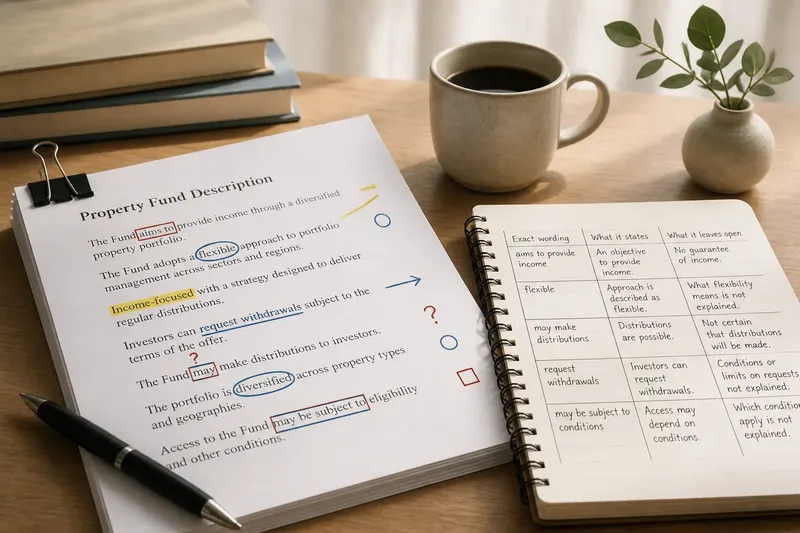
The common mistake when reading a property fund description is to treat its tone as part of its evidence. A confident phrase can make an aim sound like an outcome, or make a feature seem broader than the words support. A five-minute reading pass for fund descriptions helps you notice those effects and describe the text accurately.
What impression does the wording create?
Read the description once without stopping to look up terms. Notice which words make the fund sound dependable, accessible or appealing, then mark them for a closer look. The point is not to decide whether the language is fair; it is to see how the wording guides your interpretation.
Pay attention to adjectives and phrases such as “stable”, “income-focused”, “diversified”, “flexible” and “access”. Ask what each phrase means in the sentence, and whether the text explains the limits of that meaning. A familiar word can carry a narrower or more specific meaning in a fund description.
Use a pen or notes app and keep the marks simple:
- Underline wording that describes a stated feature or objective.
- Circle a term whose meaning is unclear in context.
- Mark with a question mark a phrase that suggests an outcome without explaining its conditions.
- Draw an arrow from a persuasive phrase to the sentence or note that explains it, if one is provided.
- Put a box around a qualification such as “aims to”, “may” or “subject to”.
- Add a margin note when a phrase seems important but the description leaves its meaning open.
Each mark should lead to a decision: keep the phrase as a direct statement, qualify your description of it, or leave a question open. Think of the marks like labels on a filing drawer: they help you sort what the text says from what it merely suggests.
How can you distinguish a claim from its persuasive effect?
For each marked phrase, write down the literal claim and the impression it might create. Keep those notes separate. The literal claim belongs to your account of the description; the impression is a response to its wording, not a fact about the fund.
For instance, “the fund aims to provide income through a diversified property portfolio” states an aim and uses the word “diversified”. It does not, by itself, say what the portfolio contains, define diversification or establish that income will be paid. Keep the qualification “aims to” attached when you describe the claim.
Say you are reading a short description that calls its approach “flexible” and says the fund “may” make distributions. You mark both phrases, then write: “The text calls the approach flexible but does not explain what that permits; it says distributions may be made, not that they will be.” The result is a precise account of the wording, with its persuasive effect separated from what it actually states.
What does the description leave for the reader to infer?
Look for places where the text moves quickly from a feature to an implied benefit. A named property type does not, on its own, explain how much of the portfolio it represents or what that mix means. A statement about access does not explain every condition that might apply to using it.
Make a small three-column note, either on paper or in a notes app:
- Exact wording: copy the short phrase you are examining.
- What it states: write only what follows directly from those words.
- What it leaves open: note the inference or question the description does not resolve.
For each row, decide whether the phrase can be repeated as written, needs a qualification, or should be described as an unanswered question. If the wording itself does not settle the point, do not fill the gap with an assumption.
Which wording questions are worth asking?
Does “income-focused” mean income is certain?
No. The phrase describes an emphasis or objective, not necessarily a payment or a particular outcome. Check whether the description explains what it means by the term and retains any qualifying language.
What does “diversified” tell me?
On its own, it tells you that the description presents the portfolio as diversified. It does not spell out the assets or how the term is being used, so avoid adding those details to your account unless the text provides them.
How should I handle “may”, “can” or “aims to”?
Keep the qualifying words in your notes and in any later paraphrase. Removing them can turn a possibility or objective into a claim that sounds certain.
What if the description leaves an impression but gives no explanation?
Record the exact phrase and state what it leaves unclear. You can then ask the provider to explain the wording or consult a qualified professional if the question affects a financial decision.
How can you finish the pass with a clear account?
Review your marks and sort them into three decisions:
- Repeat as stated: if the sentence directly identifies a feature or objective, describe it without adding an outcome.
- Qualify the wording: if a phrase includes “may”, “aims to” or another condition, retain that qualification in your account.
- Leave open: if a term or implication remains unexplained, record it as a question rather than supplying your own answer.
- Drop an inference: if your note goes beyond the actual words, remove it or label it clearly as an interpretation.
- Ask for clarification: if an unresolved phrase matters to your understanding, quote it in a direct question to the provider or a qualified adviser.
- Recheck the source: if a paraphrase sounds stronger than the original sentence, compare them and restore any omitted qualification.
Imagine a description says that investors can request withdrawals and calls its approach “flexible”. You underline the withdrawal statement, circle “flexible”, and note that the text does not explain what flexibility means or what conditions apply to requests. Your account is then: “The description says investors can request withdrawals and describes the approach as flexible; it does not explain the meaning of that term or the conditions for requests.” The wording stays precise, while the unresolved point remains visible.
A five-minute reading pass for fund descriptions is useful when it changes how you report what you have read, not when it forces a verdict. Keep the source phrase beside your note, especially when you share your interpretation. That small habit makes it easier for another reader to see where the description ends and your interpretation begins.